In response to the previous blog post, where I use the metaphor of scratch and sniff - The film below showcases a library that incorporates physical interaction and physical spaces with digital interfaces and electronic information as means to stimulate and educate children the way they like to - playing!
Monday, April 13, 2009

Saturday, April 11, 2009
Today’s Question: How Can the Architecture of the Information Age Interface and Educate a particular Culture of Use?
In response to Information Age in a Developing Context, I have set my thesis Question as: How Can the Architecture of the Information Age Interface and Educate a particular Culture of Use?
Someone can tell you, “Lavender smells like nausea and modern cosmetics”. An Online Encyclopedia can tell you it’s a mix of soothing mint, crisp basil, and a relaxing vanilla aroma, but do you then really know what lavender smells like or have you just learnt it? In the 1980’s children would swop small pieces of paper called ‘Scratch ‘n Sniff’, that allowed them to physically scratch a piece of paper thereby removing a micro-fragrance coating that released a faint odor. This basic product incorporated a physical contact that provided kids with mystery, engagement and education by interaction. The invisible virtual world of information and the World Wide Web is like a plethora of people telling you what lavender smells like.
At present we observe a world that is 100 years into the Information Age (Castells, M. 2004). Characterised by new Information and communication technologies the Information Environment is still in its infancy and is “ferociously Darwinian” in its development ( Mitchell, W. J. 1997). Progressive Information Technologies are constantly evolving and mutating, and if communities do not evolve with it they face being left behind ( Wilson, E. J. 2004). Architecture and urbanism must see this evolution as an integrated experience into the daily lives of the public instilling a culture of use and awareness ( Mitchell, W. J. 1997:4). It is important to see how the current forms of Information transference, storage and access exist in virtual realm, an invisible world that both surrounds us and eludes us. A problem occurs where this lack of physical presence manifests an invisible barrier between form and function, or rather between possibility and use.
Architecture has always imbued a relationship with the sciences and the human senses through a ‘sensorial dimension’ ( Picon, A. 2003:295). In other words, “science and technology only meet when they both contribute to the cultural construction of perception.” ( Picon, A. 2003:295). Architecture and its relationship to public space are concerned with a material-form existing in the ‘real’ (built environment). We can see it, touch it and engage with it as a physical experience. In the Information Age, Architectural form must offer its components to interface between the physical and virtual, linking information technology to new spatial programs, surfaces, experiences, and public functions ( Witte, R. 2002:72). The Civic Library as an archetype for public resource and information access plays a significant role in educating and nurturing the Information Society. The role of the public resource centre in the Information Age goes beyond providing the surface of a screen - it must update, physically interact and stimulate a culture of knowledge and innovation that is both relevant and progressive thinking. We must become a scratch and sniff information society.
Someone can tell you, “Lavender smells like nausea and modern cosmetics”. An Online Encyclopedia can tell you it’s a mix of soothing mint, crisp basil, and a relaxing vanilla aroma, but do you then really know what lavender smells like or have you just learnt it? In the 1980’s children would swop small pieces of paper called ‘Scratch ‘n Sniff’, that allowed them to physically scratch a piece of paper thereby removing a micro-fragrance coating that released a faint odor. This basic product incorporated a physical contact that provided kids with mystery, engagement and education by interaction. The invisible virtual world of information and the World Wide Web is like a plethora of people telling you what lavender smells like.
At present we observe a world that is 100 years into the Information Age (Castells, M. 2004). Characterised by new Information and communication technologies the Information Environment is still in its infancy and is “ferociously Darwinian” in its development ( Mitchell, W. J. 1997). Progressive Information Technologies are constantly evolving and mutating, and if communities do not evolve with it they face being left behind ( Wilson, E. J. 2004). Architecture and urbanism must see this evolution as an integrated experience into the daily lives of the public instilling a culture of use and awareness ( Mitchell, W. J. 1997:4). It is important to see how the current forms of Information transference, storage and access exist in virtual realm, an invisible world that both surrounds us and eludes us. A problem occurs where this lack of physical presence manifests an invisible barrier between form and function, or rather between possibility and use.
Architecture has always imbued a relationship with the sciences and the human senses through a ‘sensorial dimension’ ( Picon, A. 2003:295). In other words, “science and technology only meet when they both contribute to the cultural construction of perception.” ( Picon, A. 2003:295). Architecture and its relationship to public space are concerned with a material-form existing in the ‘real’ (built environment). We can see it, touch it and engage with it as a physical experience. In the Information Age, Architectural form must offer its components to interface between the physical and virtual, linking information technology to new spatial programs, surfaces, experiences, and public functions ( Witte, R. 2002:72). The Civic Library as an archetype for public resource and information access plays a significant role in educating and nurturing the Information Society. The role of the public resource centre in the Information Age goes beyond providing the surface of a screen - it must update, physically interact and stimulate a culture of knowledge and innovation that is both relevant and progressive thinking. We must become a scratch and sniff information society.
Tuesday, April 7, 2009
A Future Question: What did Google mean for Architecture?
INTRODUCTION:
I have asked myself, What Happens when Everywhere is Here?
“In our lifetime we are going from not everyone being able to communicate to almost everyone being able to, from not everyone having access to a library to almost everyone having access to the world’s knowledge” Eric Smidt, Google CEO
SEE INTERVIEW HERE:
Before now obtaining Information was like picking up pebbles on a private beach – if you were a member. You could hold it in your hand, fill your pockets with pebbles, take them home and go back for more. These pebbles were heavy, different shapes and sizes and your coat could only hold so many. Today Information is the ocean – liquid, and fluid. We can float on its surface and swim deep into its depths of discovery. It is formless and weightless and accessible by anyone.
In years from now, Built Environment institutions may ask their students ‘What did Google mean for Architecture?’, As one might look back today at the Industrial era and observe the effects of ubiquitous machining and industry in the creation of the modernist experience and modernist form, when answering this question future architectural students will look back at the 21st Century and examine the effects of the digital age of information systems on the city, its buildings, space-making, and the archetype functions of spatial programs - ‘What became of the public library when access to knowledge was instant and everywhere?’ In gathering these traces, students and historians will formulate a timeline illustrating how architectural form and programming altered, evolved, adapted, and sometimes completely disintegrated in order to accommodate new forms of information access, communication technologies, and digital interfaces in the rip-curl current of the information revolution - that is now.
--
Here is an interesting video that explores the changes in the way we find, store, create, critique, and share information today..
--
Here is a preview of how Standford University Library is digitizing content for the future of Libraries..
I have asked myself, What Happens when Everywhere is Here?
“In our lifetime we are going from not everyone being able to communicate to almost everyone being able to, from not everyone having access to a library to almost everyone having access to the world’s knowledge” Eric Smidt, Google CEO
SEE INTERVIEW HERE:
Before now obtaining Information was like picking up pebbles on a private beach – if you were a member. You could hold it in your hand, fill your pockets with pebbles, take them home and go back for more. These pebbles were heavy, different shapes and sizes and your coat could only hold so many. Today Information is the ocean – liquid, and fluid. We can float on its surface and swim deep into its depths of discovery. It is formless and weightless and accessible by anyone.
In years from now, Built Environment institutions may ask their students ‘What did Google mean for Architecture?’, As one might look back today at the Industrial era and observe the effects of ubiquitous machining and industry in the creation of the modernist experience and modernist form, when answering this question future architectural students will look back at the 21st Century and examine the effects of the digital age of information systems on the city, its buildings, space-making, and the archetype functions of spatial programs - ‘What became of the public library when access to knowledge was instant and everywhere?’ In gathering these traces, students and historians will formulate a timeline illustrating how architectural form and programming altered, evolved, adapted, and sometimes completely disintegrated in order to accommodate new forms of information access, communication technologies, and digital interfaces in the rip-curl current of the information revolution - that is now.
--
Here is an interesting video that explores the changes in the way we find, store, create, critique, and share information today..
--
Here is a preview of how Standford University Library is digitizing content for the future of Libraries..
Monday, April 6, 2009
Third World Data-Information Visualised
Hans Rosling, Anthropologist and statistics guru, visualizes information using his new program 'gapminder' in a way that helps you see the worlds growth and status like never before. Beautiful and incredibly insightful. See here visually what previously was only translated as numbers.
Wednesday, April 1, 2009
Moving Windmills - a story of innovation
This is a touching Short film (6min) - It is about a Young Malawian, with very little to no access to information (knowledge) He "re-invents the wheel" so to speak, creating technology in his own way that already exists but he has no access to it. what is interesting here from my angle is how he learns from images where text is unavailable or is illegible (due to illiteracy or lack of availability). Imagine you gave this guy access to the world's knowledge, and how to use it. possible innovations? - unimaginable.
Sunday, March 22, 2009
One Laptop Per Child
I thought this would make a good starting point for the blog, here are two video's promoting the incredible concept and initiative of Nicholas Negroponte's 'One Laptop Per Child' (OLPC) initiative aimed at providing less privileged communities and their children access to the world's knowledge and immense opportunities for education.
Here is the Official Site: http://www.laptop.org/en/
One Laptop per Child : Zimi's Story FULL
OLPC Mission
Here is the Official Site: http://www.laptop.org/en/
One Laptop per Child : Zimi's Story FULL
OLPC Mission
First Writings

In a developing city, access to the world's knowledge through the internet could stimulate innovation, entrepreneurship, new models of individual and community learning and perpetuate economic growth.
While, politics, economics, and infrastructure are key role players in developing systems for the correct use of Information Technologies and all communications in a city, Architecture or space-making has a role and opportunity in the communication of these developments to the public realm and could provide an extended platform of interaction, participation, transparency and communication that may propagate the creation of an urban culture of knowledge and innovation.
The purpose of the thesis is to explore the tremendous opportunities for innovation and advancement that the technologies of the information revolution might offer to the future of architecture and space making in an intelligent city. Where architecture recognises the need for a culture of technology in what is increasingly being called the Knowledge Society. The nurturing of a culture of knowledge/technology may act as a catalyst for economic advancement, public interest and innovation and new increased socio-spatial communication in an urban context.
By outlining the cultural, spatial and institutional constraints presented by a developing country’s existing systems and mentalities, I hope to identify what manoeuvrability there is for innovation in the creation of architectural space that best represents and explores the age of Technology and Information and notably in the context of an African developing city.
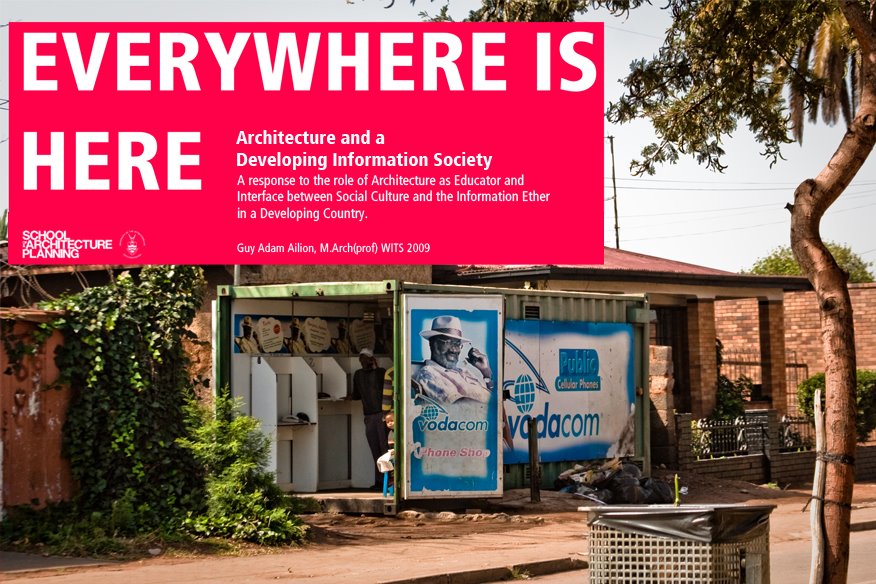
The Information Revolution and the implementation of its technologies into cities and societies is treated only as a economic and infrastructural exercise that assumes that this invisible technology will be understood and accepted at full potential by the public (end-user). Two problems surface at first glance: the first being the absence of the ‘real’ in observing and dissemination of the ‘virtual’ technology. What I mean here is that most new information technologies and their associated data are invisible. This Information ether only manifests itself through media interfaces and screens. There is need to represent these specific technologies physically and spatially where participation is on a more physically tectonic, interactive, and observable level. The second and most topical in this thesis is that of our social culture toward information and technology.
The term Culture of Technology is used here to characterize the nature of the challenges faced by developing countries and an increasing age of fast-changing technology. It also suggests a higher level of difficulty compared to just the transfer of technological hardware. The latter is mechanized and pre-determined while the former is organic and open-ended and may require a deeper level of unconscious and conscious engagement. Space-making or Architecture could be seen as the vital large scale physical manifestation that can curb the 2 problems outlined above. Where “Architecture is the built form of our cultural ambitions” (Reed Kroloff) it has the ability to tell stories, express messages, be playful, educate, and be communicative and socially interactive thus stimulating the public participator or even passer-by into the creation of a particular culture of use. Architecture sees the point of contact with the public in an urban environment and it is at this point that Information Technology could be innovative and apply more ‘real’ human activity.
Subscribe to:
Posts (Atom)