Tuesday, June 16, 2009

Thesis introduction animation: the next Library?


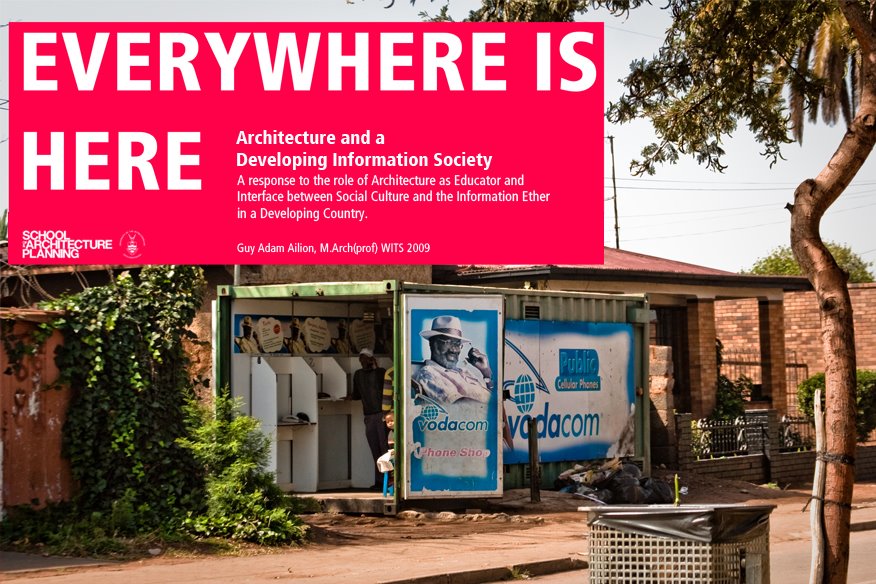
What is a library when 'everywhere is here'?
This fun architectural animation explores the question of the role of the public library when digital information is everywhere and is everything.
What happens to the spaces of books?
and how should traditional spaces of information change for a digital world?
Even better... in the developing world, how could the library nurture an information society, when people don't have access at home?
Could the future of the library be an urban information bar?
or a theatre of knowledge?
and what does that really mean anyway?

A Hole in the Wall - Public Interface Experiment

An IT executive, whose offices were in the slums of India, experimented by putting a computer in the office's perimeter wall. The poor and marginalized community have little to no access to the internet and computers. The experiment was a hit, and he observed how the youth took control, thought themselves to use the computer and browse the net and then showed their friends. The projects growth around the developing country quickly inspired the film SLUMDOG MILLIONAIRE.
The project is an amazing look at the effects of public interface and how social interaction takes place around a computer.

For more about the project here are two links:
http://www.hole-in-the-wall.com/
http://www.greenstar.org/butterflies/Hole-in-the-Wall.htm


In South Africa, a project called the 'Digital Doorway' (DD) has recently launched and was inspired by the Hole in the Wall experiment in India. The DD is a more robust computer and is placed in extremely rural and isolated areas for small communities.

Monday, June 1, 2009

Future of the surface?

What will 'surface' mean in the future, is everthing a screen?

Interactive Architecture

Exploring the concept of playing with information and architecture for the application of tomorrow's library as an immersive theatre of knowledge unlike any experience we have on our home PC's or cell-phones. What can a library offer in today's information age so that it may re-invent itself. These video's are worth thinking about.


Bloomberg ICE (Klein Dytham Architects):


Others:


Wednesday, May 20, 2009

Virtual Cloud as a Facade Metaphor

As I further my writing, I have been exploring the metaphor of 'Ether' to describe the nature of the virtual flow of digital data. Digital data or virtual data exists today by way of the internet, wireless, wifi, and TCP Packets. These Information Technologies are perpetuating the concept of that 'everywhere is here' and information exists like a cloud of ether that surrounds us and we can tap into it from anywhere. As the design phase of my project approaches, I will be exploring metaphors for representing an age of digital information and a knowledge society. Toyo Ito, in his personal writings and building the Sendai Mediatheque, was one of the first Architects to explore architectonic representation for the Information Age. I have been aware of wind-generated Kinetic facade design, and believe the two projects below to be a very good examples of execution. The design of kinetic facade for me makes for a very appropriate response to the metaphor of the 'ether'. I will explore this type of facade further.


Monday, April 13, 2009

Interactive Children's Library

In response to the previous blog post, where I use the metaphor of scratch and sniff - The film below showcases a library that incorporates physical interaction and physical spaces with digital interfaces and electronic information as means to stimulate and educate children the way they like to - playing!

Saturday, April 11, 2009

Today’s Question: How Can the Architecture of the Information Age Interface and Educate a particular Culture of Use?

In response to Information Age in a Developing Context, I have set my thesis Question as: How Can the Architecture of the Information Age Interface and Educate a particular Culture of Use?

Someone can tell you, “Lavender smells like nausea and modern cosmetics”. An Online Encyclopedia can tell you it’s a mix of soothing mint, crisp basil, and a relaxing vanilla aroma, but do you then really know what lavender smells like or have you just learnt it? In the 1980’s children would swop small pieces of paper called ‘Scratch ‘n Sniff’, that allowed them to physically scratch a piece of paper thereby removing a micro-fragrance coating that released a faint odor. This basic product incorporated a physical contact that provided kids with mystery, engagement and education by interaction. The invisible virtual world of information and the World Wide Web is like a plethora of people telling you what lavender smells like.

At present we observe a world that is 100 years into the Information Age (Castells, M. 2004). Characterised by new Information and communication technologies the Information Environment is still in its infancy and is “ferociously Darwinian” in its development ( Mitchell, W. J. 1997). Progressive Information Technologies are constantly evolving and mutating, and if communities do not evolve with it they face being left behind ( Wilson, E. J. 2004). Architecture and urbanism must see this evolution as an integrated experience into the daily lives of the public instilling a culture of use and awareness ( Mitchell, W. J. 1997:4). It is important to see how the current forms of Information transference, storage and access exist in virtual realm, an invisible world that both surrounds us and eludes us. A problem occurs where this lack of physical presence manifests an invisible barrier between form and function, or rather between possibility and use.
Architecture has always imbued a relationship with the sciences and the human senses through a ‘sensorial dimension’ ( Picon, A. 2003:295). In other words, “science and technology only meet when they both contribute to the cultural construction of perception.” ( Picon, A. 2003:295). Architecture and its relationship to public space are concerned with a material-form existing in the ‘real’ (built environment). We can see it, touch it and engage with it as a physical experience. In the Information Age, Architectural form must offer its components to interface between the physical and virtual, linking information technology to new spatial programs, surfaces, experiences, and public functions ( Witte, R. 2002:72). The Civic Library as an archetype for public resource and information access plays a significant role in educating and nurturing the Information Society. The role of the public resource centre in the Information Age goes beyond providing the surface of a screen - it must update, physically interact and stimulate a culture of knowledge and innovation that is both relevant and progressive thinking. We must become a scratch and sniff information society.